



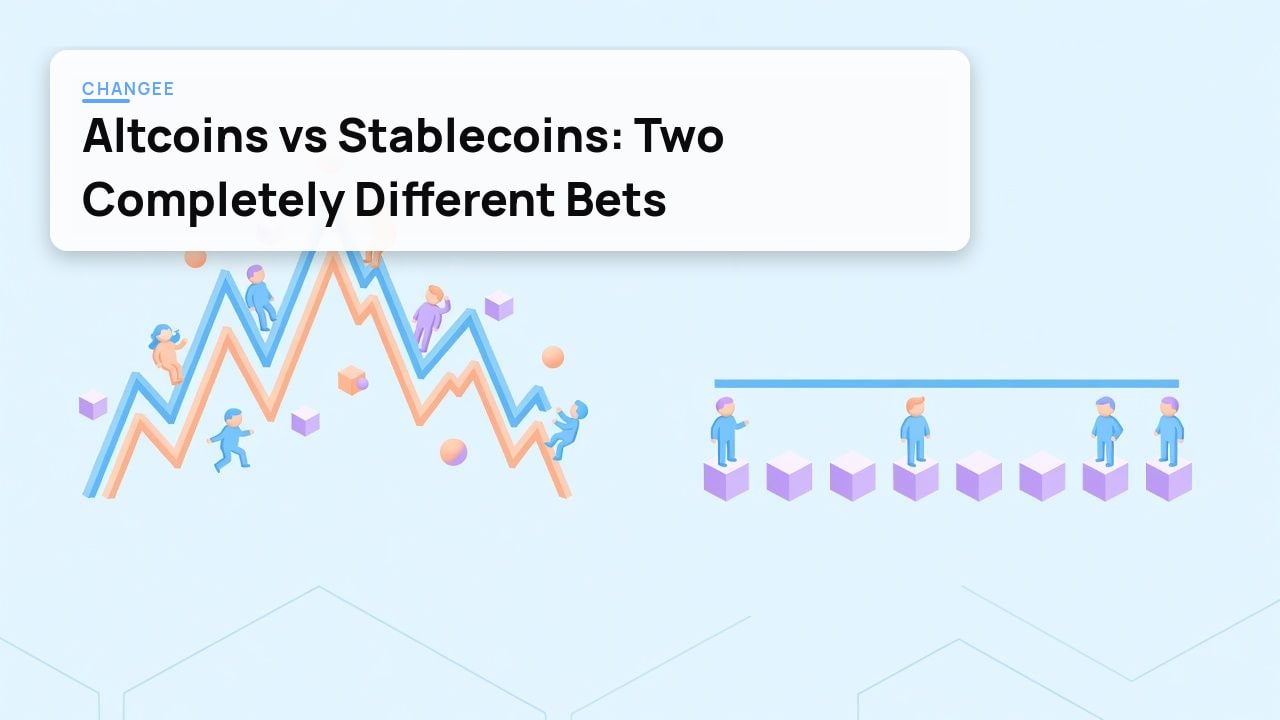
Altcoins vs Stablecoins: Two Completely Different Bets
Defining Altcoins and Stablecoins
Altcoins encompass every cryptocurrency other than Bitcoin. This broad category includes major assets such as Ethereum as well as thousands of smaller tokens and protocols. Stablecoins, by contrast, are cryptocurrencies engineered to hold a steady value, most often through a peg to the U.S. dollar or another fiat currency.
Because stablecoins exhibit markedly lower price volatility than typical altcoins, many market-data platforms isolate them when calculating total cryptocurrency capitalization or sector performance. This separation reflects their distinct risk profile and primary role as a medium of exchange or store of value rather than a speculative growth asset.
As of August 30, 2026, Stablecoin Beat reported a combined stablecoin market capitalization of $301.7 billion. Within that total, USDT accounted for $183.4 billion, representing 60.8 percent dominance, while USDC stood at $74.0 billion, or 24.5 percent dominance. These figures underscore how concentrated the stablecoin segment remains even as the broader altcoin universe continues to expand.
Market Size Snapshot as of Late August 2026
Total cryptocurrency market capitalization reached $2,623.60 billion on August 29, 2026, according to MacroMicro data. Bitcoin accounted for $1.57 trillion of that figure on August 30, placing its dominance near 60 percent. Ethereum stood at $296.49 billion on the same date. The altcoin sector excluding Bitcoin exceeded $1 trillion as of August 22, 2026, per CryptoQuant figures reported by Blockonomi.
Stablecoin supply totaled $301.7 billion on August 30, 2026, per Stablecoin Beat, which tracks more than 300 tokens. Within that segment, Tether (USDT) held $183.4 billion while USD Coin (USDC) reached $74.0 billion. The stablecoin market had contracted 2.3 percent, or $7.2 billion, over the preceding 90 days.
| Category | Market Cap (USD) | Dominance | 90-Day Change | Source & Date |
|---|---|---|---|---|
| Total Crypto Market | $2.624 trillion | 100% | Not reported | MacroMicro, Aug 29 2026 |
| Bitcoin | $1.57 trillion | ~60% | Not reported | CoinScreener, Aug 30 2026 |
| Ethereum | $296.49 billion | ~11% | Not reported | CoinScreener, Aug 30 2026 |
| Altcoins ex-Bitcoin | >$1 trillion | ~38% | +$215 billion (3 days) | CryptoQuant via Blockonomi, ~Aug 22 2026 |
| Stablecoins (total) | $301.7 billion | ~11.5% | -2.3% ($7.2 bn) | Stablecoin Beat, Aug 30 2026 |
| USDT | $183.4 billion | 60.8% of stablecoins | Not reported | Stablecoin Beat, Aug 30 2026 |
| USDC | $74.0 billion | 24.5% of stablecoins | Not reported | Stablecoin Beat, Aug 30 2026 |
Figures vary slightly across providers; stablecoin.com listed $290.4 billion for the same category on August 30, while DefiLlama-derived reports showed approximately $304.56 billion on August 29. Bitcoin dominance readings ranged between 56 and 57 percent in late-August trackers from CoinPaprika and related sources. These snapshots illustrate the relative weight of each segment entering September 2026.
Volatility and Return Expectations
USD-pegged stablecoins are engineered to hold a consistent value near one dollar through reserves and arbitrage, resulting in minimal price fluctuations for holders. Altcoins lack these mechanisms and display pronounced volatility, where prices can rise or fall sharply on sentiment, adoption news, or market cycles.
This contrast showed clearly in late August 2026. Altcoin market capitalization surged by $215 billion over three days ending around August 22, demonstrating the rapid appreciation possible in these assets. During the same window, stablecoin market capitalization contracted 2.3 percent, or $7.2 billion, over the prior 90 days through August 30, reflecting adjustments in supply rather than price instability for users.
Return expectations align with these profiles. Altcoin strategies target substantial gains from volatility, with participants accepting drawdowns in pursuit of outsized upside during favorable periods. Stablecoin holders seek capital preservation, deploying the assets for liquidity or as a buffer without expecting meaningful price growth. The $215 billion altcoin increase illustrates the reward potential that attracts speculative flows, while the stablecoin contraction highlights resilience in the peg amid shifting conditions. Allocation choices therefore balance growth objectives against the need for stability.
Core Use Cases and Holder Motivations
Stablecoins function mainly as operational tools within trading environments. Market participants use them to park capital between trades, execute pairs on exchanges, and move value across borders without converting to traditional banking rails. In payments they support merchant settlements and remittances where value stability matters more than upside potential. DeFi protocols depend on them for collateral in lending markets and for deep liquidity in automated market makers, where predictable pricing prevents liquidation cascades.
Altcoins serve different ends. Holders typically acquire them to speculate on protocol adoption, to obtain governance rights that influence treasury or fee parameters, or to stake tokens that secure networks and earn issuance rewards. In DeFi they enable yield strategies tied to native token economics and provide exposure to new application layers such as decentralized derivatives or oracle services. These activities directly contribute to network effects by increasing on-chain activity and validator sets.
The two categories address incompatible priorities. Stablecoin users seek to minimize price variance so capital can remain productive or transferable; altcoin participants accept variance in exchange for governance influence or growth participation. Using one in place of the other usually defeats the original objective, whether that is preserving liquidity buffers or aligning incentives with a developing blockchain.
Moving Between the Two Asset Classes
Traders frequently rotate between altcoins and stablecoins to adjust risk exposure or pursue yield. Registration-free swaps on a non-custodial exchange simplify the process while preserving self-custody.
Changee offers Fixed Rate protection on these conversions, locking the quoted price at the moment of order placement. The platform supports direct pairs such as BTC, ETH, or USDT to XMR, allowing holders to move value into privacy-focused assets without intermediate steps.
- Choose the input asset and desired output on the swap interface, confirming the Fixed Rate quote before proceeding.
- Copy the deposit address and send the exact amount from a personal wallet; hardware-wallet users should verify the address on-device.
- Monitor the transaction through the explorer link provided; once confirmed, the output arrives in the destination wallet.
- For added privacy, repeat the swap using a fresh subaddress and route through Tor or a VPN.
Changee applies AML screening on all flows, so identity verification may be requested in specific compliance situations even though no KYC is required for most swaps. Always compare the final received amount against the quoted Fixed Rate to confirm execution quality before repeating the process in either direction.
FAQ
Does Changee require KYC for swaps?
Changee does not require KYC for most cryptocurrency swaps. However, transactions flagged by compliance procedures may be subject to additional review and identity verification.
What causes stablecoin depegs?
Depegs occur when market stress, reserve shortfalls or liquidity shocks push a token below its intended value. USDT and USDC have each briefly traded below one dollar during past events, requiring holders to decide whether to hold or exit quickly.
When is altcoin season likely to start?
Altcoin seasons often follow Bitcoin dominance peaks above 55 percent and strong inflows into Total2. Recent data showed a $215 billion surge in altcoin market cap over three days in late August 2026, hinting at possible rotation but offering no timing guarantee.
How does tax treatment differ between altcoins and stablecoins?
Altcoin trades usually trigger capital gains or losses on each disposal, while stablecoin transfers between like-pegged assets may avoid immediate taxable events in some jurisdictions. Always consult local rules before swapping.
What allocation logic works between the two classes?
Many traders keep 10-30 percent in stablecoins for dry powder and the rest in altcoins for growth, adjusting based on volatility tolerance and Bitcoin dominance trends. Rebalancing quarterly helps maintain the chosen split.
Can I swap USDT for XMR on Changee without registration?
Changee offers registration-free swaps with Fixed Rate protection on BTC, ETH and USDT to XMR pairs. Most users complete these transactions without identity verification, though compliance flags can still trigger review.