



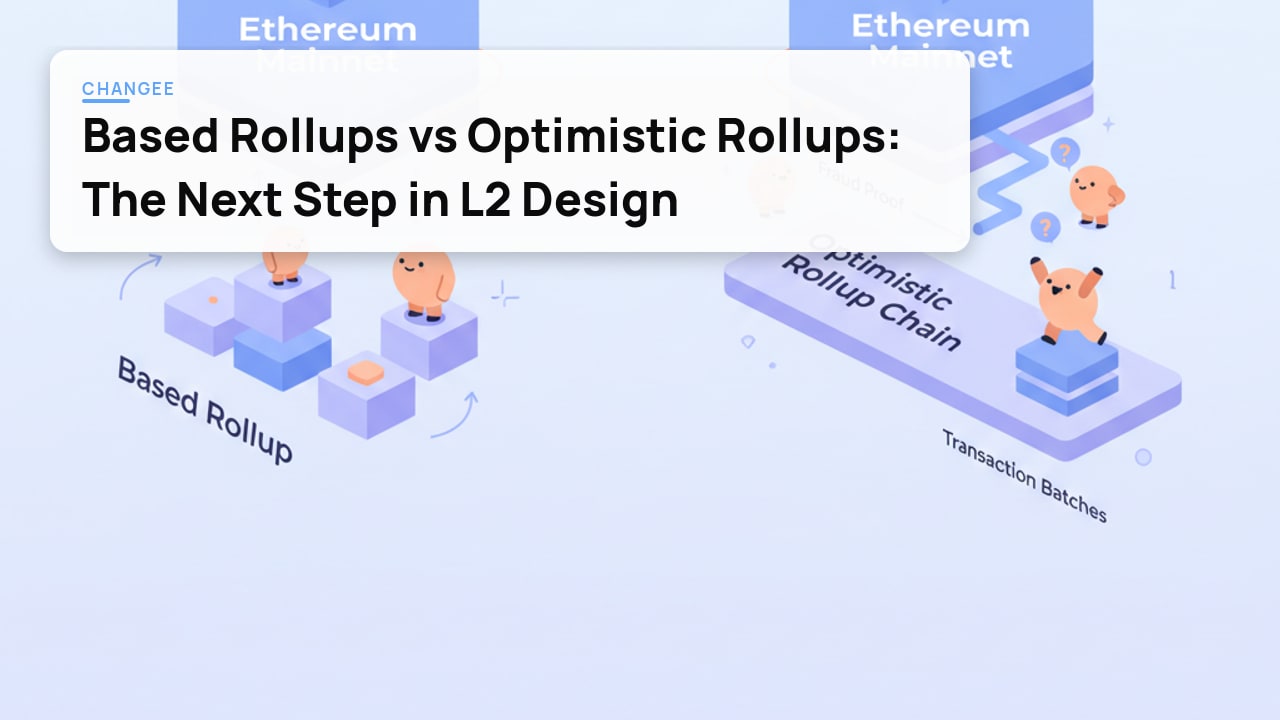
Based Rollups vs Optimistic Rollups: The Next Step in L2 Design
How Optimistic Rollups Work Today
Optimistic rollups assume that off-chain transaction batches are valid by default. They post compressed transaction data as calldata or blobs, together with state roots, to Ethereum for data availability and security.
A fraud-proving scheme underpins this model. During a challenge period that typically lasts seven days, anyone can submit a fraud proof disputing an invalid assertion. The proof forces re-execution of the transaction on L1. If no valid challenge occurs, the batch finalizes and withdrawals become possible.
Major optimistic rollups include Arbitrum One running the Nitro stack with BoLD proofs, OP Mainnet, and Base on the OP Stack. As of 2026-09-14, L2Beat and growthepie data show Base Chain total value secured between $14.63B and $14.84B, Arbitrum One between $12.18B and $12.36B, and OP Mainnet at approximately $1.70B. These figures reflect the liquidity dominance of optimistic designs within the broader Ethereum L2 ecosystem.
Based Rollups and L1 Sequencing
Based rollups delegate transaction sequencing to the Ethereum L1 proposer and builder pipeline instead of operating a dedicated sequencer. Ethereum validators include rollup blocks directly inside L1 blocks, so the rollup inherits L1 liveness, censorship resistance, and consensus without maintaining a separate sequencer network or additional consensus layer.
Taiko implements this model as a ZK rollup. Proposals are submitted through an Inbox contract on Ethereum L1. Forced inclusion acts as a permissionless fallback that guarantees any transaction can eventually enter the rollup even if the primary path is unavailable. A preconfirmation whitelist supports the fast path by allowing selected participants to issue quick assurances to users before full L1 settlement. Taiko’s current Unzen rollout combines these elements to deliver based sequencing while preserving the ability to post data and settle on Ethereum.
Because sequencing is handled by L1 proposers, based designs remove the need for an independent operator set yet still allow the rollup to choose its validity proof system. The Inbox contract, forced inclusion, and preconfirmation whitelist together provide both censorship resistance and improved user experience within the same framework.
Side-by-Side Comparison of Key Metrics
As of 2026-09-14, optimistic designs continue to dominate total value secured while based sequencing remains an emerging model implemented primarily through Taiko as a ZK rollup. The following table summarizes the core differences using L2Beat and related data.
| Metric | Based Rollups | Optimistic Rollups |
|---|---|---|
| Sequencing Model | Delegated to Ethereum L1 proposer/builder pipeline with forced inclusion fallback via Inbox contract | Dedicated sequencer network with separate consensus layer |
| Finality Time | Minutes to hours when paired with validity proofs (Taiko Unzen rollout) | ~7-day challenge period before batch finalization |
| Withdrawal Speed | Minutes to hours once proofs verified on L1 | Full ~7-day challenge window on canonical bridges |
| Security Inheritance | Direct L1 liveness, censorship resistance, and consensus via validator inclusion | L1 settlement for data and state roots with fraud-proving window |
| Current TVS Share (2026-09-14) | Emerging; Taiko not separately quantified in top figures | Base $14.63B–$14.84B, Arbitrum One $12.18B–$12.36B, OP Mainnet $1.70B (rollups total $33.33B) |
Optimistic rollups hold the majority of ecosystem value, with Base and Arbitrum One alone accounting for roughly 80 percent of the $33.33B rollup TVS reported by L2Beat. Based designs avoid a separate sequencer but currently lack comparable liquidity depth. Withdrawal and finality advantages favor validity-proof implementations regardless of sequencing choice, while optimistic chains retain broader application coverage. Hybrids such as Base’s Azul upgrade aim to shorten the seven-day window without full migration to based sequencing.
TVS Distribution and Hybrid Developments
As of 14 September 2026, L2Beat and growthepie data place total value secured across rollups at approximately $33.33 billion, with the broader Ethereum L2 ecosystem ranging from $39.8 billion to $42.36 billion. Base Chain leads the leaderboard at $14.63 billion to $14.84 billion, while Arbitrum One sits second at $12.18 billion to $12.36 billion; OP Mainnet trails at roughly $1.70 billion. These two dominant chains together account for the majority of secured value within the rollup segment.
Hybrid proof systems are narrowing the gap between optimistic and validity-based designs. Base is rolling out the Azul upgrade, which pairs SP1 ZK proofs with trusted hardware attestations. When the proofs align, native withdrawal finality drops from the standard seven-day challenge window to a single day. Mantle has completed its transition to validity proofs, and Taiko launched directly with a ZK-based model that incorporates based sequencing. These moves demonstrate how optimistic stacks can incrementally adopt ZK components without discarding their existing fraud-proof infrastructure, allowing faster finality while preserving current liquidity and application ecosystems.
User Trade-offs and Practical Steps
Optimistic rollups deliver deep liquidity pools on chains such as Base and Arbitrum One, yet they impose a seven-day challenge window before withdrawals finalize on Ethereum. Based rollups, by contrast, inherit L1 sequencing and enable faster finality once validity proofs are verified, but currently support thinner liquidity and fewer applications. Users therefore weigh rapid exit options against the capital efficiency available on established optimistic networks.
Censorship resistance follows the same split. Based designs route ordering through Ethereum validators and include a permissionless forced-inclusion path on Taiko’s Inbox contract, reducing reliance on a single sequencer. Optimistic stacks maintain dedicated sequencers that can reorder or delay transactions until forced exits are exercised.
When moving assets between L2s, registration-free non-custodial swaps such as Changee let users exchange BTC, ETH or USDT for privacy-focused assets like XMR without creating an account. Most swaps complete with no KYC for most users, though identity verification may be requested in specific compliance situations. Changee’s Fixed Rate option locks the quoted price during the transfer window, shielding traders from volatility while they migrate positions. Self-custody remains essential: withdraw to a hardware wallet, verify each transaction on-device, and generate fresh subaddresses before swapping.
FAQ
How does finality differ between optimistic and based rollups?
Optimistic rollups require a seven-day challenge window before withdrawals finalize on Ethereum L1. Based designs paired with validity proofs reach finality in minutes to hours once the proof is verified.
What is Taiko forced inclusion?
Taiko lets users submit transactions directly to an Inbox contract on Ethereum L1 as a permissionless fallback when the preconfirmation whitelist is unavailable.
Why do optimistic rollups have long withdrawal delays?
The canonical bridge waits out the full fraud-proof challenge period, typically seven days, before releasing funds on L1.
Can Base shorten its withdrawal delay?
Base plans to reduce native withdrawal finality to one day through its Azul upgrade when SP1 ZK proofs match trusted hardware attestations.
When should users consider a registration-free swap service like Changee?
Traders moving between BTC, ETH, USDT and XMR often choose registration-free platforms for privacy-focused, non-custodial exchanges that avoid dedicated sequencer dependencies.
Does Changee require KYC?
Changee does not require KYC for most cryptocurrency swaps. However, transactions flagged by compliance procedures may be subject to additional review and identity verification.