



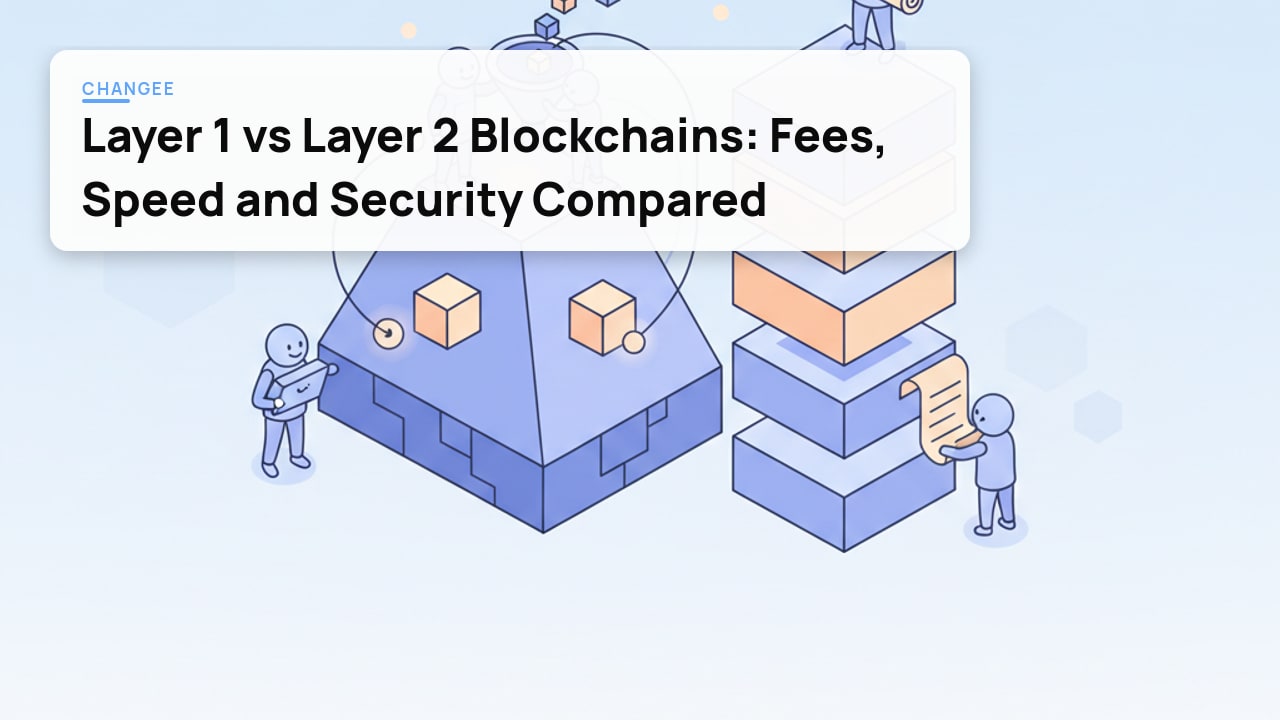
Layer 1 vs Layer 2 Blockchains: Fees, Speed and Security Compared
Layer 1 and Layer 2 Fundamentals
Monolithic Layer 1 blockchains such as Ethereum and Solana maintain native security through their dedicated validator sets and consensus mechanisms. Ethereum relies on its proof-of-stake validator network, while Solana uses Proof of History combined with its validator set to achieve high throughput. These base layers handle settlement, data availability and execution directly on-chain.
Layer 2 solutions, primarily optimistic and zero-knowledge rollups built on Ethereum, shift most execution off the base layer yet post periodic state commitments or validity proofs back to the L1. This mechanism allows L2s to inherit the bulk of Ethereum’s security guarantees without operating independent validator sets. Optimistic rollups assume transactions are valid unless challenged during a dispute window, whereas ZK rollups submit cryptographic proofs that verify correctness immediately upon posting.
These designs introduce extra trust assumptions absent on pure L1s. Users must trust sequencer honesty for transaction ordering and, in optimistic systems, the challenge period before withdrawals finalize. Solana, as a monolithic L1, avoids such intermediate assumptions but carries its own validator and liveness risks tied to its single consensus layer.
Transaction Fees: L1 Versus L2 Data
Fee data from 2026 Q1 shows Ethereum Mainnet median transaction fees at $0.012283, a 99.68 percent drop from $3.786300 in 2024 Q1. Leading L2s posted an average fee of $0.001512, down 99.16 percent from $0.180219 over the same period. Solana recorded a median fee of $0.000496, down 27.80 percent from $0.000687.
| Chain | 2026 Q1 Median/Avg Fee | Decline Since 2024 Q1 | Sept 14 2026 Median Fee |
|---|---|---|---|
| Ethereum Mainnet | $0.012283 | 99.68% | $0.051 |
| Leading L2s (Arbitrum, Base, Optimism) | $0.001512 | 99.16% | Under $0.01 (often ~$0.001) |
| Solana | $0.000496 | 27.80% | $0.000555 (non-vote) |
By September 14 2026, Ethereum Mainnet median fees had risen to $0.051 while average fees reached $0.193. L2 fees stayed routinely below $0.01. Batching allows L2s to amortize Layer 1 data costs across hundreds of transactions, while data availability layers further reduce posted calldata expenses. Solana maintains low fees through its monolithic architecture without separate data availability fees, though its non-vote median sat at $0.000555 on the same September date.
Throughput and Transaction Speed
As of 2026 Q1, Ethereum Mainnet averaged 25.78 TPS, combined Layer 2 solutions reached 226.92 TPS, and Solana recorded 1,303.46 TPS. These quarterly figures reflect sustained growth from 2024 Q1 baselines of 13.67, 78.60, and 804.72 TPS respectively. Recent snapshots show further divergence: Solana observations on September 14, 2026, hit approximately 4,685 TPS when non-vote transactions were emphasized.
Ethereum upgrades including Dencun in March 2024, Pectra in May 2025, and Fusaka in December 2025 doubled capacity on both Mainnet and Layer 2s by raising gas limits from roughly 30 million to 60 million and expanding blob data availability. Layer 2 throughput benefits directly from batching while inheriting these base-layer gains.
Methodology differences complicate direct comparisons. Solana TPS varies sharply depending on whether validator votes are included, while Layer 2 metrics hinge on batch definitions and data-posting frequency. Quarterly averages therefore sit below peak snapshots, particularly for Solana where 1,300 TPS quarterly contrasts with recent readings above 4,000 TPS.
Security Trade-offs and Finality
Layer 1 blockchains such as Ethereum deliver native security through dedicated validator sets and consensus mechanisms. Layer 2 solutions inherit the majority of this protection by posting periodic state commitments or validity proofs to the L1, yet they add trust assumptions around sequencer honesty and challenge periods. Optimistic rollups enforce a standard seven-day withdrawal delay to permit fraud-proof submissions, extending the time users must wait before funds become available on the base layer. ZK rollups bypass this delay with cryptographic validity proofs that enable near-immediate finality once the proof is verified on Ethereum. Base-layer L1s provide direct finality without these intermediate steps, though high-throughput monolithic chains like Solana introduce separate validator and liveness risks tied to their Proof-of-History architecture. When validator participation drops or network congestion spikes, these L1s can experience temporary stalls that affect transaction ordering and confirmation. The resulting trade-off means users gain speed and lower costs on L2s or high-performance L1s but must weigh added trust assumptions or potential liveness issues against the straightforward security model of a native L1 validator set.
Recent Upgrades and New Chains
Ethereum has executed a series of protocol upgrades starting with the Dencun hard fork in March 2024, which introduced blobs for data availability. Follow-on changes including Pectra in May 2025, Fusaka in December 2025, and subsequent blob-parameter updates raised gas limits from roughly 30 million to 60 million while expanding blob capacity. These adjustments doubled TPS on Mainnet and Layer 2 networks and drove median fees lower.
As of 2026 Q1, Mainnet averaged 25.78 TPS with a median transaction fee of $0.012283, a 99.68 percent reduction from 2024 Q1 levels. Solana sustained higher throughput, posting 1,303.46 TPS on average in the same quarter and reaching observed snapshots near 4,685 non-vote TPS by mid-September 2026, alongside a median non-vote fee of $0.000496.
Circle’s purpose-built Arc L1 is scheduled for public mainnet launch on September 16, 2026. The chain targets sub-second deterministic finality specifically for stablecoin settlement and related use cases.
FAQ
How do current Ethereum L1 fees compare to leading L2s?
As of 2026 Q1 data, Ethereum Mainnet median fee stood at $0.012283 while the average across Arbitrum, Base and Optimism reached $0.001512. By mid-September 2026, Ethereum median fees had risen slightly to around $0.051, yet L2 fees routinely remain under $0.01 and often near $0.001 for simple transfers.
Which chain offers the highest real-world throughput?
Solana recorded 1,303.46 TPS on average in Q1 2026 and reached snapshots above 4,685 TPS later that year. Combined L2s averaged 226.92 TPS while Ethereum Mainnet averaged 25.78 TPS over the same period.
When should users prefer L2s over base-layer L1s?
Choose L2s for routine transfers or DeFi activity when fees below one cent and batch finality suffice. Opt for Ethereum L1 or Solana when direct settlement without challenge periods or sequencer assumptions is required.
What withdrawal delays affect optimistic rollups?
Optimistic rollups impose a typical seven-day challenge window before funds can exit to Ethereum L1, whereas ZK rollups achieve faster finality through validity proofs posted directly to the base layer.
How did recent Ethereum upgrades change the fee landscape?
The Dencun upgrade in March 2024 and subsequent Pectra and Fusaka releases doubled TPS on both Mainnet and L2s while expanding gas limits from 30 million to 60 million and increasing blob capacity, driving median fees down more than 99 percent from 2024 levels.
Are new purpose-built L1s entering the market?
Arc by Circle is scheduled for mainnet launch on 16 September 2026, targeting sub-second deterministic finality specifically for stablecoin settlements and competing with existing high-throughput options.