



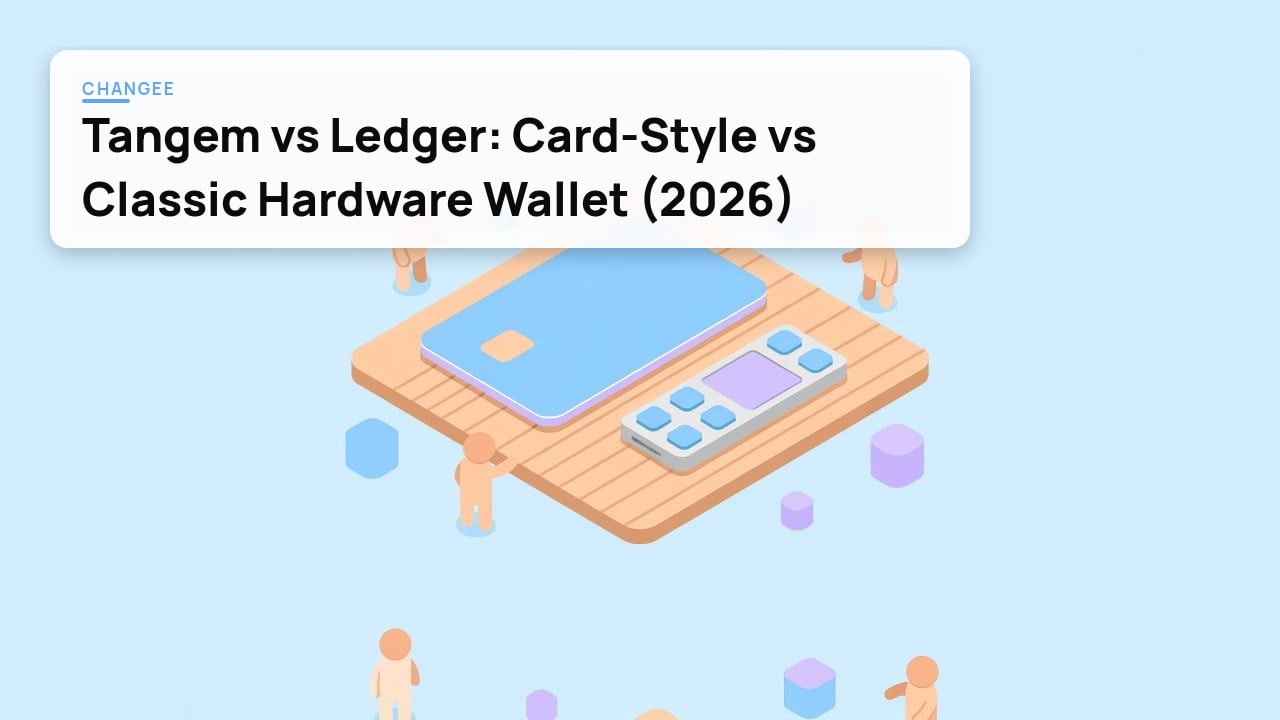
Tangem vs Ledger: Card-Style vs Classic Hardware Wallet (2026)
Deciding between Tangem vs Ledger in 2026 comes down to weighing card-style NFC convenience against classic USB hardware wallets with screens. Both deliver strong self-custody options, yet their designs, security trade-offs, and daily workflows differ significantly.
Form Factor and Hardware Design
Tangem wallets adopt a credit-card-sized NFC format that stores keys inside an EAL6+ secure element chip. These cards contain no battery, screen, or ports, so connectivity occurs exclusively through NFC to a companion mobile app. The default configuration is seedless, with multiple identical cards functioning as physical backups that share the same keys.
Ledger devices follow a classic hardware-signer layout built around USB-C ports, with Bluetooth available on select models. Each unit includes an on-device screen for transaction verification and relies on a mandatory 24-word seed phrase backup that users can extend with an optional passphrase or Recovery Key. Ledger supports both desktop and mobile interaction via the Ledger Live application.
Durability profiles diverge because of these choices. Tangem cards remove common failure points such as batteries and connectors while offering a 25-year limited hardware warranty. Ledger units deliver visual confirmation through their screens yet depend on standard ports and components whose firmware can receive updates, unlike Tangem’s immutable firmware. Both product lines employ secure-element chips rated EAL5+ or EAL6+, yet the physical designs emphasize different priorities: portability and minimal surface area for Tangem, on-device verification and ecosystem reach for Ledger.
Security Models and 2026 Attack Analysis
Tangem cards rely on an EAL6+ secure element with immutable firmware, eliminating the possibility of post-manufacture code changes. This design reduces the attack surface by removing update vectors but also prevents patches if vulnerabilities emerge. Ledger devices, by contrast, feature on-device screens that let users verify transaction details before signing, paired with firmware that supports updates to address new threats.
On July 9, 2026, Ledger Donjon disclosed a laser fault-injection attack targeting Tangem cards. The technique bypasses the password-recovery check on the EAL6+ chip, enabling a password reset without the original code or a backup card. Execution requires physical access to the card, laboratory equipment costing around $250,000, and roughly two hours per card once parameters are known. Because the firmware is immutable, the attack cannot be patched through software updates.
Tangem stated that the attack remains laboratory-only, invasive, and resource-intensive, posing virtually nonexistent risk to users who keep their cards physically secure. No user fund losses have been reported from this vector. Ledger’s findings underscore that both products ultimately depend on physical protection of the hardware; however, Ledger’s updatable firmware and visible transaction checks provide different mitigation paths against evolving physical and remote threats.
Pricing and Market Performance Data
Tangem lists its 2-card pack at $54.90 and its 3-card pack at $69.90 on the official site as of September 2026. Ledger’s current lineup shows wider spreads: Nano S Plus between $59 and $79, Nano X at $99, Nano Gen5 at $179, Flex at $249, and Stax at $399 on shop.ledger.com.
| Model / Pack | Price (USD) |
|---|---|
| Tangem 2-card pack | $54.90 |
| Tangem 3-card pack | $69.90 |
| Ledger Nano S Plus | $59–$79 |
| Ledger Nano X | $99 |
| Ledger Nano Gen5 | $179 |
| Ledger Flex | $249 |
| Ledger Stax | $399 |
Tangem reported $61.3 million in 2025 revenue, a 102 percent year-over-year rise according to The Block, and has shipped more than 6 million cards through mid-2026. Ledger states it has sold over 8 million devices that secure approximately 20 percent of global crypto assets as of 2026. These figures place Tangem’s card-based volumes against Ledger’s broader device footprint and higher average selling prices on premium models.
Asset Support and Ecosystem Compatibility
Secondary sources report wide variation in asset coverage for both wallets. Tangem support is described as ranging from 85+ blockchains and 1,000+ tokens to claims of 14,100+ or 16,000+ tokens. Ledger figures span 70+ networks or 5,500+ assets up to 15,000+ supported cryptocurrencies. Official sites do not publish exact unified counts, making direct comparisons difficult.
Ledger Live provides desktop and mobile access with broader third-party integrations. Tangem relies on its companion mobile app connected via NFC, which restricts desktop functionality and focuses compatibility within the app environment.
These discrepancies in reported numbers across reviews underscore the absence of standardized, manufacturer-verified totals for either platform.
Everyday Usability and Integration Options
Tangem setup starts when a user taps any card to a smartphone NFC reader inside the companion app; keys generate on the EAL6+ chip and identical copies are created on backup cards without ever exposing a seed phrase. Ledger setup routes through Ledger Live on desktop or mobile, where the device prompts the user to record a 24-word phrase and confirm each word on its screen before the wallet activates.
Signing flows follow the same hardware constraints. Tangem transactions complete only after the card is held against the phone for NFC authentication inside the mobile app. Ledger devices display the full transaction details on their built-in screen for user approval, whether the request arrives via USB, Bluetooth, or the Ledger Live desktop client.
DeFi access differs in reach. Tangem surfaces yield and swap options directly inside its mobile app, suiting users who stay within one interface. Ledger routes to external dApps and protocols through Ledger Live plus third-party wallet connections, giving desktop users wider choice without leaving their primary workstation.
Mobile-first holders therefore finish most checks and approvals in seconds with Tangem. Desktop-heavy traders gain more granular control and multi-screen verification when they keep a Ledger device tethered to a computer running Ledger Live.
FAQ
How do Tangem and Ledger handle wallet recovery?
Tangem uses multiple identical cards that share the same keys for physical backup, eliminating the need for a seed phrase. Ledger relies on a standard 24-word seed phrase backup, with optional passphrase support.
Is the July 2026 laser fault-injection attack on Tangem practical?
The attack requires physical card access, laboratory equipment costing around $250,000, and roughly two hours per card. Ledger Donjon disclosed it on July 9, 2026, and it has not led to reported user losses due to the high barriers involved.
Which hardware wallet suits beginners better?
Ledger offers broader desktop and mobile compatibility through Ledger Live and on-device screens for verification. Tangem provides a simpler NFC mobile experience with no battery or ports required.
Which device is preferable for high-value holdings?
Ledger models with on-device transaction verification appeal to users prioritizing visible confirmation steps. Tangem's EAL6+ secure element and 25-year warranty suit those focused on minimal connectivity surfaces.
Do swaps on platforms like Changee require identity verification?
Changee does not require KYC for most cryptocurrency swaps. However, transactions flagged by compliance procedures may be subject to additional review and identity verification.
Can either wallet support privacy-focused swaps like BTC to XMR?
Both devices sign transactions for use with registration-free, non-custodial platforms such as Changee that enable BTC, ETH, or USDT to XMR exchanges without registration for most users.