



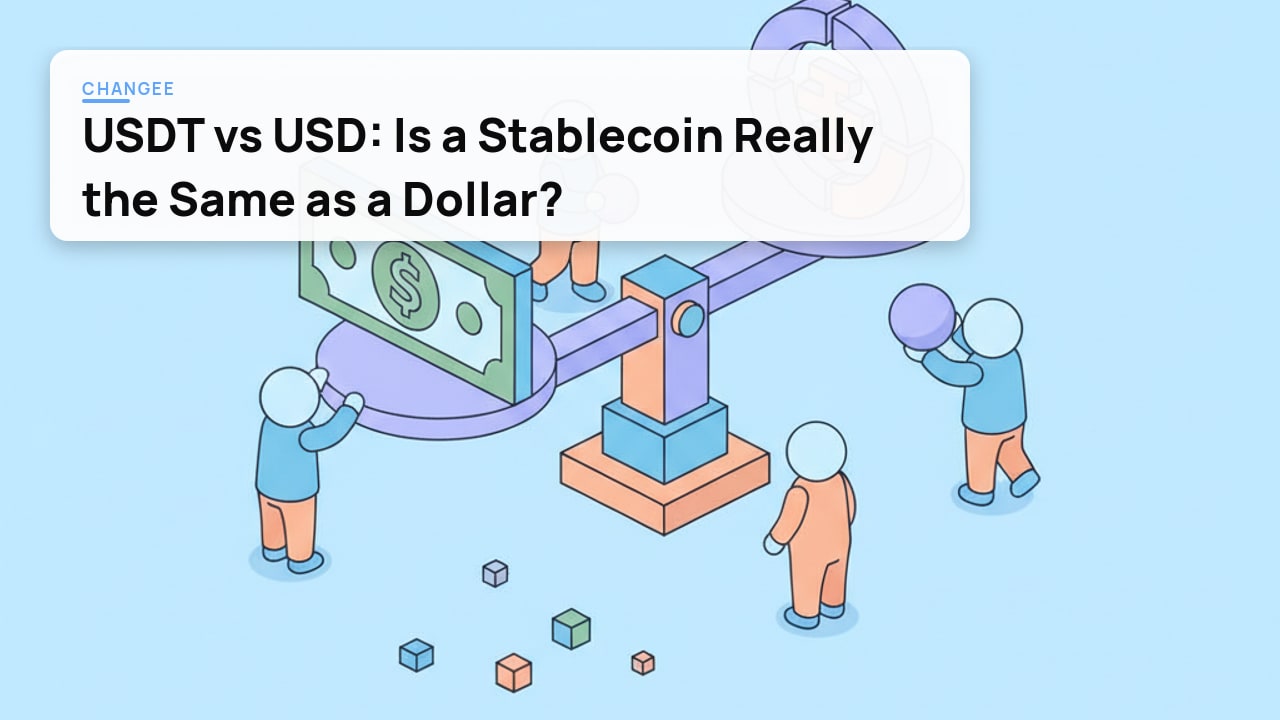
USDT vs USD: Is a Stablecoin Really the Same as a Dollar?
What the US Dollar Actually Is
When comparing USDT vs USD, the US dollar functions as the official fiat currency of the United States, issued exclusively by the Federal Reserve System, the nation’s central bank. Congress established this authority through legislation that grants the Federal Reserve sole responsibility for managing the dollar’s supply and value. As a fiat currency, its worth stems from government decree and public confidence in the US economy rather than any commodity backing or private reserves.
Federal law designates the dollar as legal tender, requiring creditors to accept it for settlement of debts, taxes, and other obligations within the United States. This status derives directly from sovereign authority, giving the currency uniform acceptance across all fifty states and territories. The federal government reinforces this position through its taxing power and ability to enforce contracts denominated in dollars.
Direct government backing means the dollar rests on the full faith and credit of the United States, without reliance on external issuers or asset pools. Monetary policy decisions by the Federal Reserve, including adjustments to interest rates and reserve requirements, determine supply dynamics. This framework keeps the currency tied to national fiscal and economic policy rather than private balance sheets or redemption mechanisms.
How USDT Is Created and Backed
Tether International issues USDT by minting new tokens only after receiving equivalent value in reserves, maintaining a claimed 1:1 peg to the US dollar. When institutions deposit USD or other approved assets, Tether creates the corresponding USDT supply; the reverse occurs on redemption, where tokens are burned.
The reserve composition extends beyond cash. As of June 30, 2026, Tether International reported total assets of $187,751,426,411 against liabilities of $183,641,897,215, leaving excess reserves of $4,109,529,196. US Treasury bills accounted for $114,960,963,604 of assets, while gold holdings exceeded 146 metric tons valued at $18,838,357,171. Additional holdings include Bitcoin, secured loans, and other investments whose market values can fluctuate.
Direct redemption remains limited to verified institutional customers meeting a $100,000 minimum, with fees and processing times set at Tether’s discretion. Retail holders rely on secondary-market liquidity and arbitrage to sustain the peg near $0.9997 as of September 14, 2026.
Tether publishes daily circulation figures and quarterly BDO ISAE 3000R attestations that confirm reserve balances at a specific date. These point-in-time reports differ from full audits because they do not examine internal controls, ongoing asset valuations, or operational risks across the entire period.
USDT vs USD: Direct Comparison
| Aspect | USDT | USD |
|---|---|---|
| Issuer | Tether International, S.A. de C.V. | Federal Reserve (US government) |
| Backing Assets | US Treasury bills ($114.96 billion as of June 30, 2026), gold (>146 metric tons valued at $18.84 billion), secured loans and other investments; total assets $187.75 billion vs liabilities $183.64 billion | Full faith and credit of the US government; deposits insured by FDIC up to applicable limits |
| Regulatory Oversight | Quarterly BDO ISAE 3000R attestations (point-in-time); no direct FDIC or government deposit insurance | Direct Federal Reserve and FDIC oversight with government-backed insurance |
| Historical Depeg Events | Maintains peg near $1 via arbitrage and liquidity; traded at approximately $0.9997 as of September 14, 2026 | Functions as the reference unit; no peg mechanism required |
| Redemption Process | Restricted to verified institutional customers; minimum $100,000; fees of at least $1,000 or 0.1%; one-time $150 verification fee; processing can take several days at Tether's discretion | Direct access through banks or Federal Reserve for eligible institutions; retail via insured deposits |
| Counterparty Risk | Issuer and reserve fluctuation risk; holders do not own reserves or receive gains above face value | Minimal for insured deposits; sovereign backing reduces exposure |
The table highlights structural differences that affect how each asset behaves in practice. USDT relies on Tether's reserve management and secondary-market mechanisms, while USD operates under direct governmental authority. These distinctions influence liquidity access, transparency reports, and exposure to operational or market shifts in the backing portfolio.
When and Why the Two Diverge
USDT can separate from the USD in value or liquidity when secondary-market conditions break down or reserve composition raises concerns. The peg depends on arbitrage and trading depth rather than open redemption. Retail users have no direct access to Tether’s window; only verified institutions qualify, subject to a $100,000 minimum, 0.1 percent fees, and multi-day processing.
Reserve assets beyond cash equivalents introduce volatility. As of the June 30, 2026 BDO attestation, holdings included more than 146 metric tons of gold and secured loans, whose market values can shift independently of the dollar. Excess reserves fell sharply to $4.11 billion from the prior quarter’s $8.23 billion, narrowing the buffer that absorbs such movements.
Point-in-time attestations, rather than continuous audits, leave room for temporary gaps between reported assets and liabilities. When trading volume thins or confidence dips, USDT can trade below one dollar on exchanges until arbitrage restores the link. Liquidity shortages on specific chains can also create localized premiums or discounts that persist until cross-market flows rebalance supply.
These separations remain short-lived in most cases because market makers and institutional redemptions eventually realign prices, yet they highlight the ongoing distinction between holding USDT and holding actual dollars.
Swapping Between USDT and Privacy Assets
Traders who hold USDT often seek ways to move into privacy-focused assets such as Monero (XMR) without creating unnecessary on-chain links. Changee provides registration-free swaps that let users exchange USDT directly for XMR or other privacy coins in a non-custodial environment. Most swaps complete with no KYC for most users, though identity verification may be requested in specific compliance situations.
The platform supports Fixed Rate protection on USDT-to-XMR trades, locking the quoted rate for the duration of the transaction so volatility does not alter the final amount received. Because the service is non-custodial, funds never sit on an exchange wallet; the swap executes atomically once the user confirms the deposit address.
Users who value privacy typically generate a fresh subaddress for each transaction and route traffic through Tor or a VPN before initiating the swap. This approach keeps the movement from USDT into XMR outside centralized ledgers while still benefiting from the liquidity and speed of stablecoin rails. The same flow works in reverse when converting privacy coins back to USDT for spending or bridging.
FAQ
How are USDT reserves verified?
Tether publishes daily circulation data and releases quarterly BDO ISAE 3000R attestations. The June 30, 2026 report showed total assets of $187.75 billion against liabilities of $183.64 billion, leaving an excess reserve buffer of $4.11 billion. These are point-in-time confirmations rather than comprehensive audits.
What are the redemption limits for USDT?
Direct redemption is restricted to verified institutional customers. The minimum is $100,000 USD equivalent, with a redemption fee of the greater of $1,000 or 0.1 percent plus a one-time $150 verification fee. Processing can take several days and approval rests at Tether’s discretion.
How does USDT recover from depegs?
The peg is maintained through arbitrage, secondary-market liquidity, and issuer minting or redemption. On September 14, 2026 the market price stood at approximately $0.9997, showing the mechanism kept the token close to parity despite earlier volatility.
Is USDT insured like a bank deposit?
No. USDT carries issuer and counterparty risk with no FDIC or government deposit insurance. Holders do not own the underlying reserves or receive gains above face value if those assets appreciate.
When does USDT function identically to USD?
USDT functions like USD for most on-chain transfers, trading pairs, and payments where counterparties accept it at face value. It diverges when direct redemption, regulatory treatment, or reserve transparency become relevant, because only institutions meeting Tether’s criteria can convert large amounts back to dollars.
Can retail users redeem USDT directly for dollars?
Retail holders generally cannot. Redemption channels are limited to approved institutional accounts; most users rely on exchanges or over-the-counter desks that maintain their own liquidity and compliance processes.